
Approximate Time to Complete: 1-2 Hours + Questions & Journal Time
About this experiment
This experiment can be an exciting way to dive deeper into the concept of phase changes introduced in the Different Properties at Different Temperatures lesson.
What you’ll learn
- How to supercool water
- What “supercooling” means
- 3 bottles of purified water (NO MINERALS)
- Tap water
- Bag of ice cubes
- 1 cup salt
- Metal bowl
- Plate
- Thermometer
- Timer
- What are some of the differences between liquids and solids?
- How can you turn water from liquid to solid?
- At what temperature does water freeze?
- How long does it take for water to freeze?
Before you begin, put your “patient pants” on. This experiment can be very particular and may take a couple of tries. Trust us though, when you finally get it, the excitement is worth it!
Part 1: Supercooling the Water
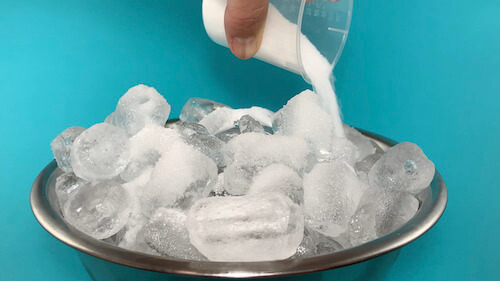
- Empty one of the water bottles, fill it with tap water, and close the lid. Label it “tap water.”
- Fill the metal bowl halfway with ice.
- Place all of the water bottles on top of the ice.
- Add more ice to fully cover the bottles.
- Pour tap water over the ice until the bowl is about ¼ full.
- Sprinkle a layer of salt over the ice.
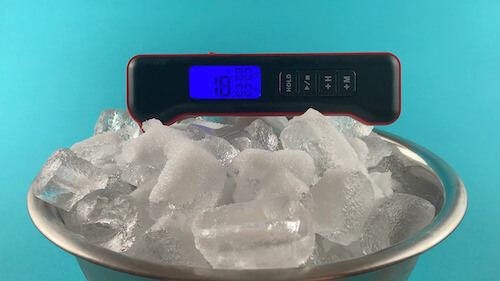
- Put the thermometer into the bowl. Wait until the temperature reaches 16-19 °F (-9 to -7 °C).
- Set a timer for 45 minutes. Add more ice and salt as needed to keep the temperature between 16-19 °F (-9 to -7 °C).
- After 45 minutes, check the tap water bottle. It should be partially frozen. If it’s not, set a timer for 5 more minutes and check again. The larger your bottles are the longer they’ll need to freeze.
- When the tap water bottle is partially frozen but the purified water bottles are still liquid, you’re ready for parts 2 and 3.
Part 2: Instant Ice in a Bottle
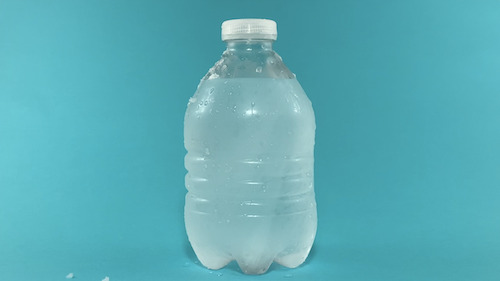
- Carefully take one purified water bottle out of the ice bath.
- Gently hit the bottom on the counter a few times. Watch for ice crystals to form inside the bottle.
Part 3: Instant Ice Tower
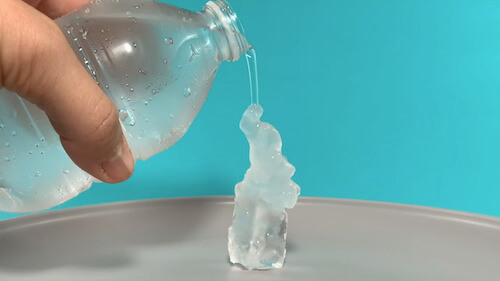
- Place an ice cube on a plate.
- Carefully take one purified water bottle out of the ice bath.
- Open the bottle and pour the water onto the ice cube. The water should instantly freeze as it touches the ice.
- What needs to happen for water to turn into ice?
- Does water freeze as soon as it gets cold, or can it stay liquid even below its freezing temperature?
- Why do you think the tap water froze before the purified water?
- Do you think this experiment would work with other liquids besides water?
Pre-experiment Questions
- What are some of the differences between liquids and solids?
Liquids can flow and change shape while solids keep their shape. In liquids, the particles can move around. In solids, the particles are locked into place.
- How can you turn water from liquid to solid?
You can turn water from liquid to solid by cooling it down to a low enough temperature until it freezes.
- At what temperature does water freeze?
32°F (0°C)
- How long does it take for water to freeze?
It depends on how cold it is, how much water there is, and the container you’re using.
Questions & Further Research
- What needs to happen for water to turn into ice?
The water molecules have to organize into a solid pattern. It’s like carefully building a card house.
- Does water freeze as soon as it gets cold, or can it stay liquid even below its freezing temperature?
It can stay liquid for a little while below its freezing temperature. This is called supercooling. The water cools down, but the molecules haven’t organized into solid ice yet.
- Why do you think the tap water froze before the purified water?
The minerals in tap water act like starting points that help the water molecules start lining up into ice. Purified water doesn’t have those, so it takes longer for ice crystals to start forming.
- Do you think this experiment would work with other liquids besides water?
Some liquids might work, but it depends on how easily their molecules can organize into a solid. Water works especially well because its molecules fit together in a crystal shape when they freeze. In this experiment, you cool the water below its freezing temperature but the molecules haven’t lined up yet (supercooling).
When you hit the bottle on the counter, the bump helps the molecules move into position and start freezing. When you pour the supercooled water onto the ice cube, the already-frozen ice gives the water molecules a starting point to build from. That’s why the freezing spreads so quickly and creates instant ice.
Check out more free experiments!
Are you interested in seeing what Learn Libre’s big-picture lessons, hands-on experiments, and engaging science activities are all about? Check out the free lessons below!
Earth's Crust
Upper Elementary
Is the ground constantly moving beneath your feet?
Senses and Information Processing
Upper Elementary
How can your own senses play tricks on your brain?
The Water Cycle
Upper Elementary
Could we be drinking the same water that dinosaurs drank?
Magnetic Fields and Navigation
Lower Elementary
How did people navigate the world before GPS?
The First Great Lesson
Lower Elementary
Where did the stars come from? And the Sun? How was our Earth created?
A Quick Guide for Educators
Teacher Tools
A 5-minute tutorial on how to use Learn Libre lessons.